
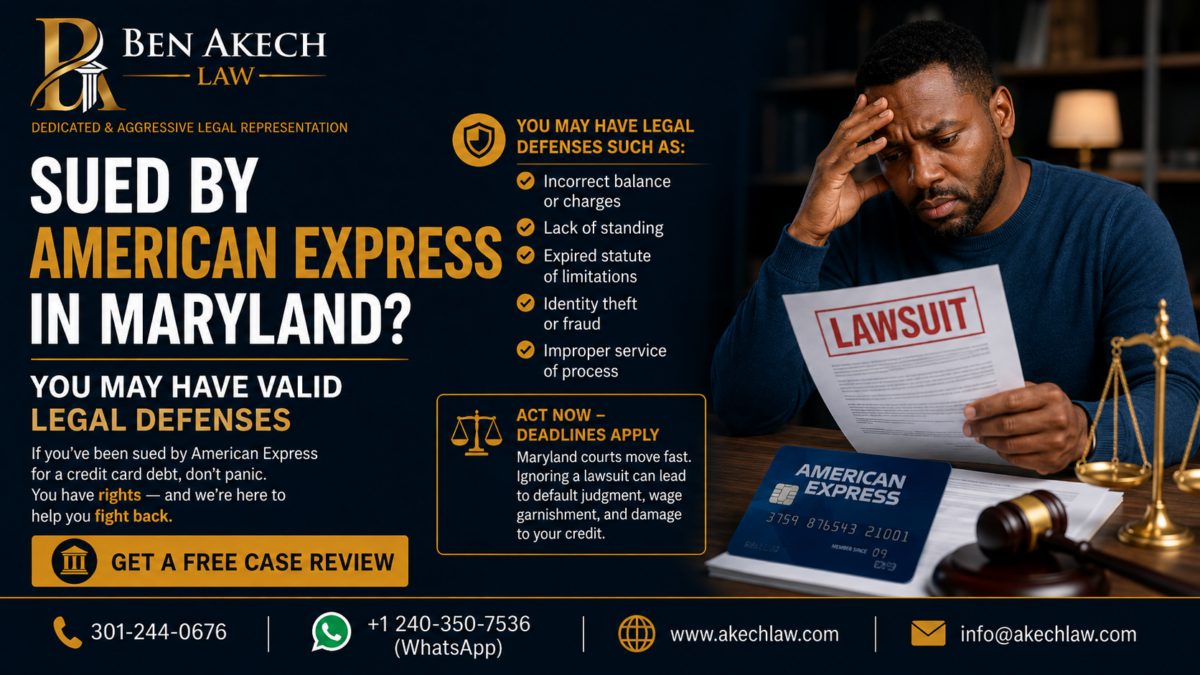
Receiving a court summons from American Express National Bank can be alarming. Unlike many other credit card issuers that sell delinquent debts to third-party debt buyers, American Express frequently retains ownership of its accounts and uses local law firms to file lawsuits directly against Maryland consumers.
If you have been served with an Amex lawsuit in a Maryland District or Circuit Court, do not panic—and do not ignore it. Being sued does not automatically mean you will lose or have to pay the full balance demanded. Depending on the details of your account, you may have strong legal defenses that can lead to a case dismissal, a balance reduction, or a favorable out-of-court settlement.
The Critical 15-Day Rule in Maryland
When served with a Writ of Summons and Complaint in a Maryland District Court, time is your most critical factor.
You generally have only 15 days from the date you receive the court papers to file a formal response—known as a Notice of Intention to Defend—with the court (or 30 days if the lawsuit was filed in Circuit Court or served out-of-state).
Important Warning: If you fail to file a response before your deadline, the court can grant American Express an automatic Default Judgment. A default judgment gives Amex the legal authority to garnish your paychecks, freeze your bank accounts, and place liens on your property.
Common Legal Defenses in Maryland Amex Lawsuits
American Express relies heavily on consumers ignoring court summonses to win quick default judgments. When you actively defend yourself, the legal burden shifts to Amex to prove every detail of their claim under Maryland rules of evidence. Here are the most common defenses used to fight an American Express lawsuit in Maryland:
1. Expired Statute of Limitations
Under Maryland law (Md. Code, Cts. & Jud. Proc. § 5-101), the standard statute of limitations for credit card debt is 3 years. The clock typically begins running from the date of your first missed payment or account default. If American Express waited longer than 3 years from your default date to file the lawsuit, the debt is time-barred and the court must dismiss the case.
(Note: Under Maryland CJP § 5-1202, making a partial payment after default does not restart the expired 3-year deadline for consumer debt.)
2. Lack of Sufficient Documentation & Chain of Evidence
To secure a judgment, American Express must produce complete, legally admissible records—including original credit agreements, account statements, and a clear accounting breakdown showing how the final balance, fees, and interest were calculated. If their legal counsel relies on incomplete summaries or unverified statements, the evidence can be challenged and excluded.
3. Inaccurate Balances, Improper Fees, or FCBA Violations
Credit card lawsuits often involve inflated balances caused by miscalculated interest, improper default rates, or uncredited payments. Under the federal Fair Credit Billing Act (FCBA), consumers have the right to dispute billing errors and unauthorized charges.
4. Identity Theft or Fraudulent Account Activity
If the American Express account was opened fraudulently or includes unauthorized charges resulting from identity theft, you are not legally liable for those balances—provided proper dispute notifications were documented.
5. Improper Service of Process
Under Maryland rules, court documents must be served correctly (either in person or via certified mail with restricted delivery). If you were not lawfully served with the Summons and Complaint, the court lacks jurisdiction over you, and the service can be legally challenged.When served with a Writ of Summons and Complaint in a Maryland District Court, time is your most critical factor.
How a Debt Defense Attorney Fights Back
Phase
Action Taken
Why It Matters
1. Immediate File
File a timely Notice of Intention to Defend
Blocks American Express from securing an automatic default judgment.
2. Evidence Audit
Analyze Amex’s court exhibits and account statements
Uncovers missing records, billing discrepancies, or statute of limitations violations.
3. Assert Defenses
File formal legal motions and affirmative defenses
Forces Amex to strictly prove their claims in court rather than relying on assumptions.
4. Settlement
Negotiate a lump-sum or structured settlement
Resolves the balance for a fraction of the original demand if going to trial isn’t ideal.
Frequently Asked Questions
Why is American Express suing me directly instead of selling the debt?
Unlike major card issuers that sell charged-off accounts to third-party collection agencies, American Express frequently retains its debt and hires local Maryland collection law firms to file lawsuits in the name of “American Express National Bank.”
Can American Express freeze my bank account in Maryland?
American Express can only freeze your bank accounts or garnish your wages after they obtain a formal court judgment or default judgment against you. They cannot touch your bank account simply by filing a lawsuit. Responding to the summons prevents an automatic judgment.
Can I settle out of court with American Express?
Yes. American Express and their legal representatives are often open to negotiating an out-of-court settlement for a reduced percentage of the debt—especially when faced with a strong, active legal defense.
Don't Wait Until Your Response Deadline Expires
A lawsuit from American Express requires immediate action. Leaving the court papers unanswered grants them automatic control over your financial assets, but filing a timely defense puts you back in control.
If you have been served with an American Express lawsuit in Maryland, contact Akech Law today for a free case evaluation. We will review your court documents, identify your best legal defenses, and help protect your income and financial security.


